
Blog
SoftWave Therapy for TMJ and Jaw Pain Relief: A Drug-Free Solution for Charleston Patients

A Drug-Free, Non-Invasive Approach to Jaw Tension, TMJ Dysfunction, and Chronic Facial Pain in Charleston, SC
If you’ve ever woken up with a sore jaw, clenched teeth, a clicking sound when you chew, or a dull ache that radiates from your jawline into your ears, temples, and neck — you already know how disruptive temporomandibular joint (TMJ) dysfunction can be. It affects how you eat, how you sleep, how you speak, and how you feel throughout the day. And for many patients, it has been a years-long problem that mouthguards, medications, and even dental procedures haven’t been able to truly resolve.
At Fix Your Pain Charleston, Dr. Jeremiah Jimerson is helping patients across Charleston and South Carolina find lasting relief from TMJ pain, jaw tension, and the cascade of related symptoms that often come with it — without drugs, without injections, and without invasive procedures. The key is SoftWave Tissue Regeneration Therapy, a regenerative healing technology that addresses the root cause of TMJ pain rather than masking it.
Why TMJ Pain Is So Difficult to Resolve on Its Own
The temporomandibular joint is one of the most complex and frequently used joints in the human body. It connects the lower jaw (mandible) to the temporal bone of the skull, and it’s involved in nearly every action your face performs — chewing, speaking, yawning, swallowing, and even subtle expressions. Surrounding this joint is a dense network of muscles, ligaments, nerves, and a small but critical articular disc that allows for smooth, coordinated movement.
When something disrupts that coordination — whether through trauma, repetitive clenching, bruxism (teeth grinding), poor cervical posture, stress-driven muscular tension, or a long-standing dental imbalance — the entire system becomes dysfunctional. Common signs and symptoms of TMJ dysfunction include:
- Jaw pain or tenderness — especially on one side, often worse with chewing or after waking
- Clicking, popping, or grinding sounds — with mouth opening, closing, or chewing
- Limited jaw mobility — difficulty fully opening the mouth or locked-jaw episodes
- Headaches and migraines — particularly in the temples or behind the eyes
- Ear pain, pressure, ringing, or fullness — often mistaken for ear infections
- Neck and upper shoulder tension — from compensatory muscular guarding
- Facial pain — that radiates along the cheeks, temples, and around the eyes
- Tooth pain or sensitivity — in the absence of any clear dental cause
What makes TMJ disorders so stubbornly resistant to traditional treatment is a simple biological reality: the affected tissues — tendons, ligaments, the articular disc, and the small muscles of mastication — have limited blood supply, are constantly in use, and respond poorly to rest. You can’t stop chewing. You can’t stop swallowing. And for most people, you can’t stop clenching at night even when you know you’re doing it. That’s why so many patients cycle through mouthguards, anti-inflammatories, muscle relaxers, and even Botox injections — only to find that the pain keeps coming back.
SoftWave Therapy offers a fundamentally different approach. Learn more about how SoftWave Tissue Regeneration Technology works.
How SoftWave Therapy Heals TMJ Dysfunction at the Cellular Level
SoftWave Tissue Regeneration Therapy uses patented electrohydraulic broad-focused supersonic acoustic waves to deliver targeted mechanical energy deep into the muscles, tendons, and joint structures surrounding the jaw — activating the body’s own biological repair processes in a way that no other non-invasive technology can replicate.
For TMJ dysfunction specifically, SoftWave triggers a powerful cascade of healing responses:
- Neoangiogenesis — SoftWave stimulates the formation of new blood vessels through the release of VEGF and eNOS, dramatically improving circulation to tissues that have been chronically starved of blood flow. For the small, hardworking muscles around the jaw, this is transformative
- Dormant stem cell activation — acoustic energy awakens resident mesenchymal stem cells within and around the joint, mobilizing them for active tissue regeneration and collagen remodeling
- Inflammation resolution — SoftWave downregulates the pro-inflammatory cytokines keeping TMJ pain in a chronic loop, replacing destructive inflammation with productive, healing-oriented biological activity
- Muscular tension release — the acoustic waves penetrate deep into the masseter, temporalis, pterygoid, and other muscles of mastication, releasing chronic tension that mouthguards and oral appliances simply cannot reach
- Scar tissue and adhesion breakdown — for patients with longstanding TMJ dysfunction, fibrous adhesions and trigger points are broken down, restoring smoother joint mechanics and a more even bite
- Nerve sensitization reduction — SoftWave calms hyperexcitable peripheral nerves that contribute to facial pain, ear symptoms, and referred headaches
The difference between SoftWave and a mouthguard is the difference between protecting a problem and resolving it. SoftWave doesn’t just shield your teeth from clenching — it addresses the underlying tissue dysfunction that is driving the clenching, the inflammation, and the pain in the first place.
SoftWave + Chiropractic: A Complete Approach to TMJ Pain
One of the most overlooked contributors to TMJ dysfunction is what’s happening in the cervical spine. The upper cervical vertebrae — particularly C1 and C2 — have a direct biomechanical and neurological relationship with the jaw. Poor cervical alignment, forward head posture, and upper cervical joint dysfunction routinely show up alongside TMJ pain, and in many patients, they are the actual primary driver of jaw symptoms.
Dr. Jimerson combines SoftWave Therapy with targeted chiropractic care to address the full picture. SoftWave heals the soft tissues of the jaw and reduces muscular tension. Chiropractic adjustments restore proper alignment and motion to the upper cervical spine, eliminating the neurological and mechanical drivers of chronic clenching and jaw imbalance.
Together, this combination delivers results that neither approach can achieve alone:
- SoftWave regenerates the damaged tissues around the jaw, restores blood supply, and resolves chronic inflammation
- Chiropractic adjustments restore cervical alignment, balance muscular tone, and remove the structural strain feeding into the TMJ
The result is faster, more complete, and more durable resolution of TMJ symptoms — the kind of relief that doesn’t come back the moment you stop wearing your mouthguard or run out of anti-inflammatory pills.
Read more about how Dr. Jimerson combines SoftWave and chiropractic care for whole-body healing.
Who Benefits Most From SoftWave Therapy for TMJ Pain
Dr. Jimerson works with a wide range of TMJ patients in Charleston and across South Carolina, including:
- Chronic clenchers and grinders — patients with nighttime bruxism whose mouthguards have stopped working or never fully addressed the pain
- Stress-driven jaw pain sufferers — professionals, parents, and students whose jaw tension flares up alongside work, family, or academic stress
- Patients with chronic headaches and migraines — especially those whose head pain has a clear connection to jaw clenching or temple tension
- Post-trauma TMJ patients — those whose symptoms began after a car accident, sports impact, or fall
- Post-dental-work patients — people who developed jaw pain after extensive dental procedures, orthodontics, or extractions
- Patients with chronic ear symptoms — ringing, pressure, or pain that ENT exams have ruled out as ear-based
- Athletes — particularly those in contact sports or who clench their jaw during heavy lifting or competitive effort
- Singers, public speakers, and musicians — whose careers depend on full jaw mobility and freedom from facial pain
If you’ve tried mouthguards, muscle relaxers, anti-inflammatories, or even Botox without lasting relief, you’re an excellent candidate to explore what SoftWave Therapy can do for your jaw. Call 843.873.6004 or book your evaluation online today.
SoftWave vs. Injections, Mouthguards, and Surgery for TMJ
The conventional treatment pathway for TMJ dysfunction tends to escalate over time: night guard first, then anti-inflammatories, then muscle relaxers, then Botox injections, and in the most severe cases, arthrocentesis, arthroscopy, or open joint surgery. The problem with this progression is that almost none of these options actually heal the affected tissues. They mask symptoms, suppress reflexes, or alter mechanics — but they do not regenerate the structures that are damaged.
SoftWave Therapy is fundamentally different. Rather than suppressing the inflammatory and muscular response, it resolves the tissue dysfunction driving it. Patients who choose SoftWave aren’t just buying temporary relief — they are investing in real regeneration of the structures around the jaw. There’s no medication, no needle, no incision, and no cumulative tissue damage from repeated injections. Treatments can be repeated as often as clinically appropriate with no negative side effects.
For patients who have been told their next option is Botox or surgery, SoftWave often represents the conservative, regenerative middle path they didn’t know existed. Learn why more Charleston patients are choosing SoftWave over injections.
What Patients Experience During and After SoftWave Treatment for TMJ
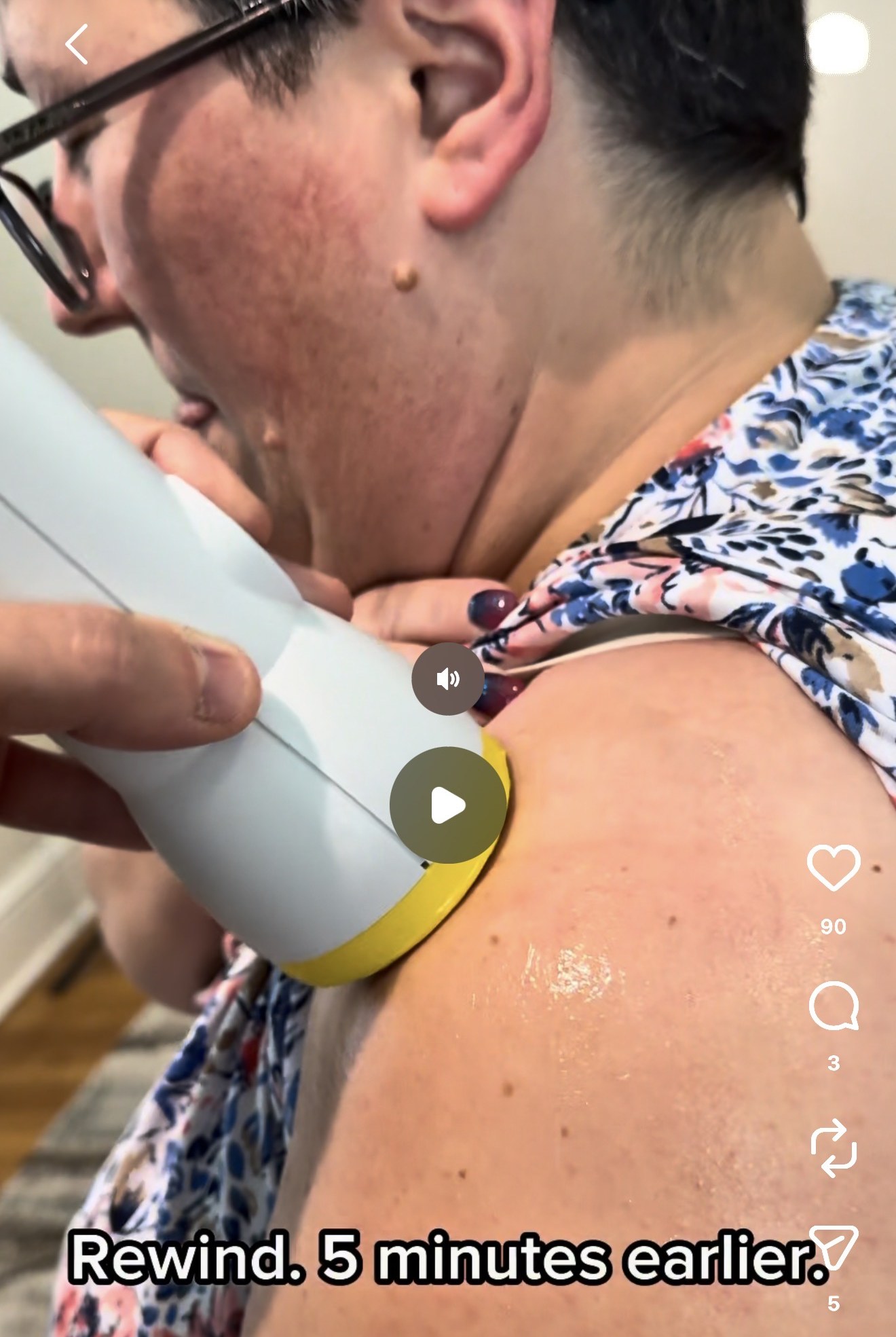
Each SoftWave session for TMJ takes approximately 15 minutes. The applicator is gently positioned over the affected jaw muscles — including the masseter, temporalis, and surrounding facial structures — and delivers comfortable, broad-focused acoustic waves into the tissue. There is no anesthesia, no needles, and no downtime. Most patients describe the sensation as a deep tapping or pulsing pressure.
In the hours after a session, some patients experience mild soreness in the jaw or temple area — a normal sign that the body’s healing cascade has been activated. This typically resolves within 24 hours and is followed by progressive improvements in jaw mobility, reduction in clenching, calmer surrounding musculature, and decreased headache frequency.
Most TMJ patients report meaningful changes within the first two to four sessions of a standard treatment series — easier chewing, less morning soreness, quieter joint sounds, and noticeable reductions in headache and ear pressure symptoms.
Stop Guarding Your Jaw. Start Healing It.
If you’ve been told to wear a mouthguard, manage your stress, take an anti-inflammatory, or simply live with your TMJ pain — know that there is a powerful, evidence-supported alternative available right here in Charleston. At Fix Your Pain Charleston, Dr. Jeremiah Jimerson is dedicated to helping TMJ patients heal completely, not just suppress symptoms one bad day at a time.
Your jaw deserves more than a piece of plastic and a prescription. It deserves real, regenerative healing — and with SoftWave Tissue Regeneration Therapy, that is exactly what’s possible.
Don’t let TMJ pain define your day. Schedule your SoftWave TMJ evaluation at Fix Your Pain Charleston today — and find out what it feels like to heal the right way.
Fix Your Pain Charleston
Dr. Jeremiah Jimerson, DC, ART
761 Saint Andrews Blvd, Charleston, SC 29407 // 843.873.6004
‹ Back




 761 St Andrews Blvd