

Blog
Heel Spurs and SoftWave Therapy: Non-Surgical Relief for Chronic Heel Pain in Charleston, SC

Non-Surgical Relief for Chronic Heel Pain in Charleston, SC — Without Drugs, Injections, or Long Layoffs
If you wake up in the morning, swing your legs out of bed, and feel a sharp, bone-deep stab in the bottom of your heel on those first few steps — you already know what living with a heel spur feels like. The pain that eases up after a few minutes of walking, only to come roaring back after standing too long. The dull ache that builds throughout the day. The frustration of running, walking, hiking, or even just being on your feet at work suddenly becoming a planning exercise around heel pain. And the bigger frustration of going to provider after provider and being told to stretch, ice, and wait it out — or worse, to consider surgery.
At Fix Your Pain Charleston, Dr. Jeremiah Jimerson is helping Charleston patients escape chronic heel spur and heel pain — without drugs, without injections, and without invasive procedures. The key is SoftWave Tissue Regeneration Therapy, and it’s changing how patients across South Carolina recover from one of the most common and most stubborn foot pain conditions.
What a Heel Spur Actually Is — and Why It Hurts So Much
A heel spur is a bony projection that develops on the underside of the heel bone (calcaneus), typically at the attachment point of the plantar fascia — the thick band of connective tissue that runs along the bottom of the foot. Heel spurs almost always develop in association with chronic plantar fascia stress, and the relationship between the two conditions is closely intertwined. Whether the pain is technically from a heel spur, from plantar fasciitis, or from both, the symptoms are similar and so is the underlying biology.
Common signs and symptoms of heel spurs and chronic heel pain include:
- Sharp morning pain — the classic stabbing pain on the first few steps of the day
- Pain after periods of rest — getting up from a desk, after a long drive, after sitting through a movie
- Aching pain throughout the day — especially after prolonged standing or walking
- Worsening pain on hard surfaces — concrete floors, tile, or barefoot on hardwood
- Tenderness on direct pressure — pressing into the bottom of the heel reproduces the pain
- Gait changes — compensatory limping that often produces knee, hip, or back pain over time
- Inability to walk barefoot comfortably
- Pain that doesn’t improve with rest — or that improves only to return on the next day of activity
The biological reason heel spurs are so stubborn comes down to circulation. The plantar fascia and the connective tissue around the heel bone have a poor blood supply. Without dramatic improvements in circulation, these tissues simply cannot regenerate the way muscle can. Rest, ice, anti-inflammatories, orthotics, and stretching can quiet symptoms — but they don’t restore the underlying tissue. Patients cycle through flare-ups for months or years.
SoftWave Tissue Regeneration Therapy is specifically built to solve this circulation-driven healing problem. Learn more about how SoftWave Tissue Regeneration Technology works.
How SoftWave Therapy Heals Heel Spur Pain at the Cellular Level
SoftWave Tissue Regeneration Therapy uses patented electrohydraulic broad-focused supersonic acoustic waves to deliver targeted mechanical energy deep into the plantar fascia and surrounding heel tissue, activating biological repair processes that no other non-invasive technology can replicate.
For heel spurs and chronic heel pain, SoftWave drives:
- Neoangiogenesis — new blood vessel formation through VEGF and eNOS release, dramatically increasing blood supply to the plantar fascia and chronic heel tissue that has been starved of circulation
- Dormant stem cell activation — awakening resident mesenchymal stem cells in and around the heel for active tissue regeneration and collagen remodeling
- Inflammation resolution — downregulating chronic inflammatory signaling and replacing it with productive healing activity
- Scar tissue and adhesion breakdown — breaking down years of accumulated fibrotic restriction in the plantar fascia that limits motion and feeds pain
- Collagen fiber realignment — supporting proper alignment of new collagen as the plantar fascia rebuilds, restoring strength and reducing re-injury risk
- Nerve sensitization reduction — calming the hyperexcitable peripheral nerves that contribute to chronic heel pain
SoftWave doesn’t just dull the morning pain. It addresses the underlying tissue dysfunction that has been driving years of symptoms.
Ready to wake up without that stabbing first-step pain? Schedule your SoftWave evaluation.
SoftWave + Chiropractic: A Complete Approach to Heel Pain
Chronic heel pain rarely lives in isolation. Foot mechanics, ankle mobility, knee position, hip strength, and pelvic alignment all influence how load is distributed through the heel with every step. Without addressing the chain above the foot, even successful tissue therapy can be undone by the next ten thousand steps.
Dr. Jimerson pairs SoftWave Therapy with targeted chiropractic care to address the full structural picture:
- SoftWave regenerates the damaged plantar fascia and surrounding heel tissue
- Chiropractic adjustments restore proper motion to the foot, ankle, knee, hip, and pelvis, eliminating the structural drivers of recurring heel overload
The combination delivers lasting relief that simply isn’t available from soft tissue therapy alone or alignment work alone.
Read more about combining SoftWave and chiropractic for whole-body recovery.
Who Benefits Most From SoftWave Therapy for Heel Spurs
Dr. Jimerson works with heel pain patients across the spectrum:
- Patients with long-standing chronic heel pain — months or years of symptoms that haven’t resolved with conservative care
- Patients who’ve already had cortisone injections — especially those whose relief was temporary and now want a regenerative option
- Runners and walkers — whose volume has triggered chronic plantar fascia dysfunction
- Workers who stand all day — nurses, teachers, restaurant and hospitality workers, retail staff, trades professionals
- Patients with high-arch or flat-foot mechanics — whose biomechanics predispose to heel overload
- Patients with weight management considerations — for whom load on the heel is amplified
- Pickleball, tennis, and court-sport players — whose lateral movement loads the plantar fascia heavily
- Patients facing potential plantar fasciotomy surgery — for whom a regenerative option may offer a better path forward
If chronic heel pain is shaping your day around what you can and can’t do, you’re an excellent candidate to explore SoftWave. Call 843.873.6004 or book your evaluation online today.
SoftWave vs. Cortisone, Orthotics, and Surgery for Heel Spurs
The conventional pathway for chronic heel pain usually escalates from rest, ice, anti-inflammatories, and stretching to orthotics, night splints, cortisone injections, and eventually surgical consultation for plantar fasciotomy or heel spur removal. The problem with that pathway is that most of it doesn’t actively rebuild the damaged tissue. Cortisone temporarily reduces inflammation but has been shown to weaken plantar fascia tissue over repeated injection cycles and can even contribute to rupture in some patients. Surgery, when indicated, comes with significant rehab timelines and is irreversible.
SoftWave is fundamentally different. Rather than masking symptoms or surgically altering anatomy, it stimulates the body’s own regenerative biology to repair the plantar fascia and the surrounding tissue. There’s no needle, no incision, and no cumulative tissue damage from repeated treatment.
Learn why more Charleston patients are choosing SoftWave over cortisone injections.
What Patients Experience During and After SoftWave Treatment for Heel Spurs
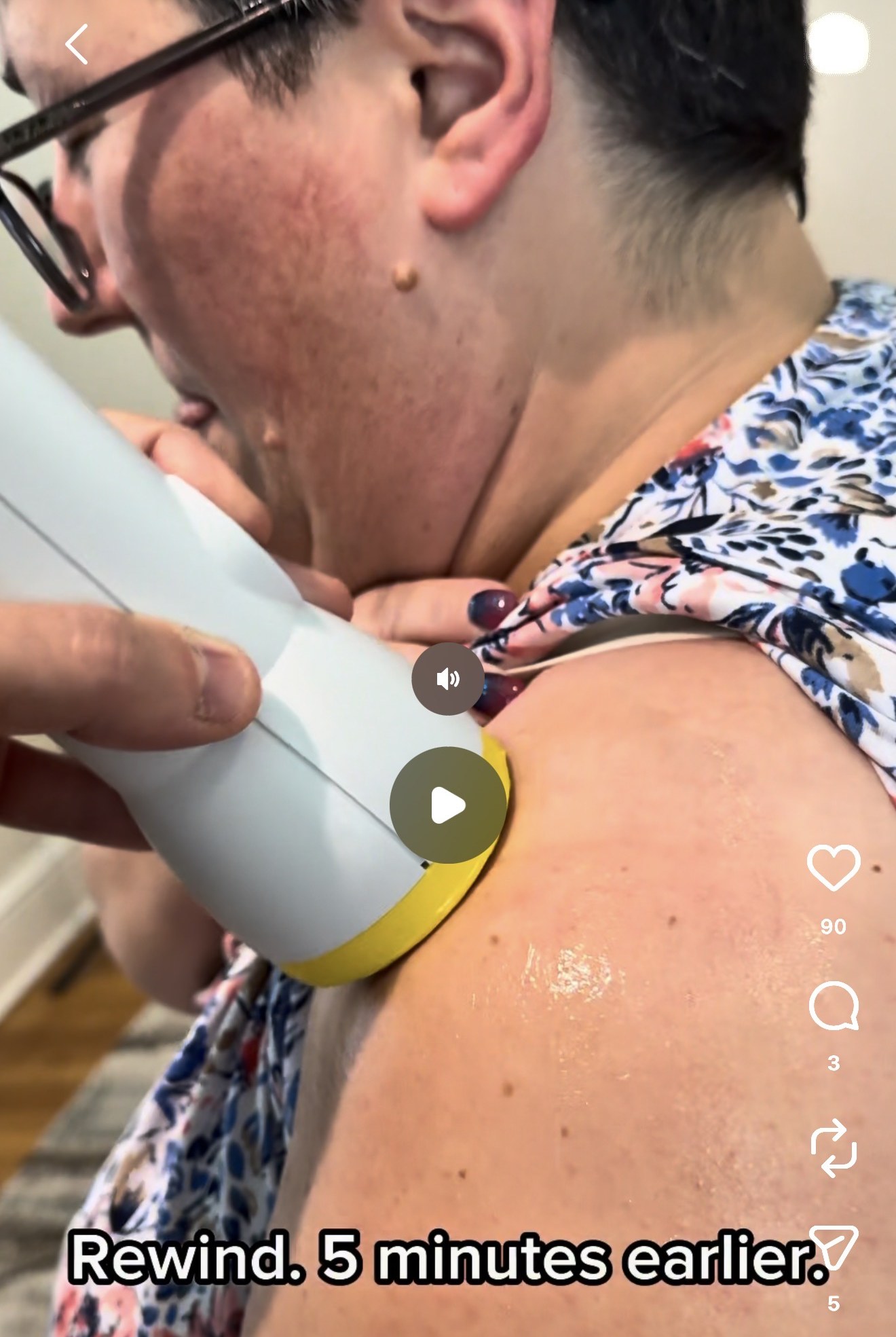
Each SoftWave session for heel spur and plantar fascia treatment takes approximately 15 minutes. The applicator is placed directly over the plantar fascia, the heel insertion point, and surrounding tissue, delivering comfortable acoustic waves into the area. No anesthesia, no needles, and no downtime. Most patients describe a pulsing or tapping pressure that often produces immediate change in tissue quality.
Some mild post-session soreness in the heel for up to 24 hours is normal — a sign that the healing response has been activated. After that, the trajectory is progressive: easier first steps in the morning, less afternoon ache, and dramatically better tolerance to walking, standing, and impact activity.
Most heel pain patients report meaningful change within the first two to four sessions of a standard treatment series.
Stop Limping Around It. Start Healing It.
If you’ve been told to stretch more, ice more, get a different shoe, or just live with chronic heel pain — know that there is a powerful, evidence-supported alternative right here in Charleston. At Fix Your Pain Charleston, Dr. Jeremiah Jimerson is helping heel pain patients heal completely — not just modify around it.
Your feet carry you through every day of your life. They deserve more than another night splint and another prescription. They deserve real, regenerative healing — and with SoftWave Tissue Regeneration Therapy, that is exactly what’s possible.
Don’t let chronic heel pain dictate your steps. Schedule your SoftWave evaluation at Fix Your Pain Charleston today — and find out what it feels like to heal the right way.
Fix Your Pain Charleston
Dr. Jeremiah Jimerson, DC, ART
761 Saint Andrews Blvd, Charleston, SC 29407 // 843.873.6004
‹ Back



 761 St Andrews Blvd