

Blog
How SoftWave Finds the Exact Source of Pain — When MRIs, Injections, and PT Can't
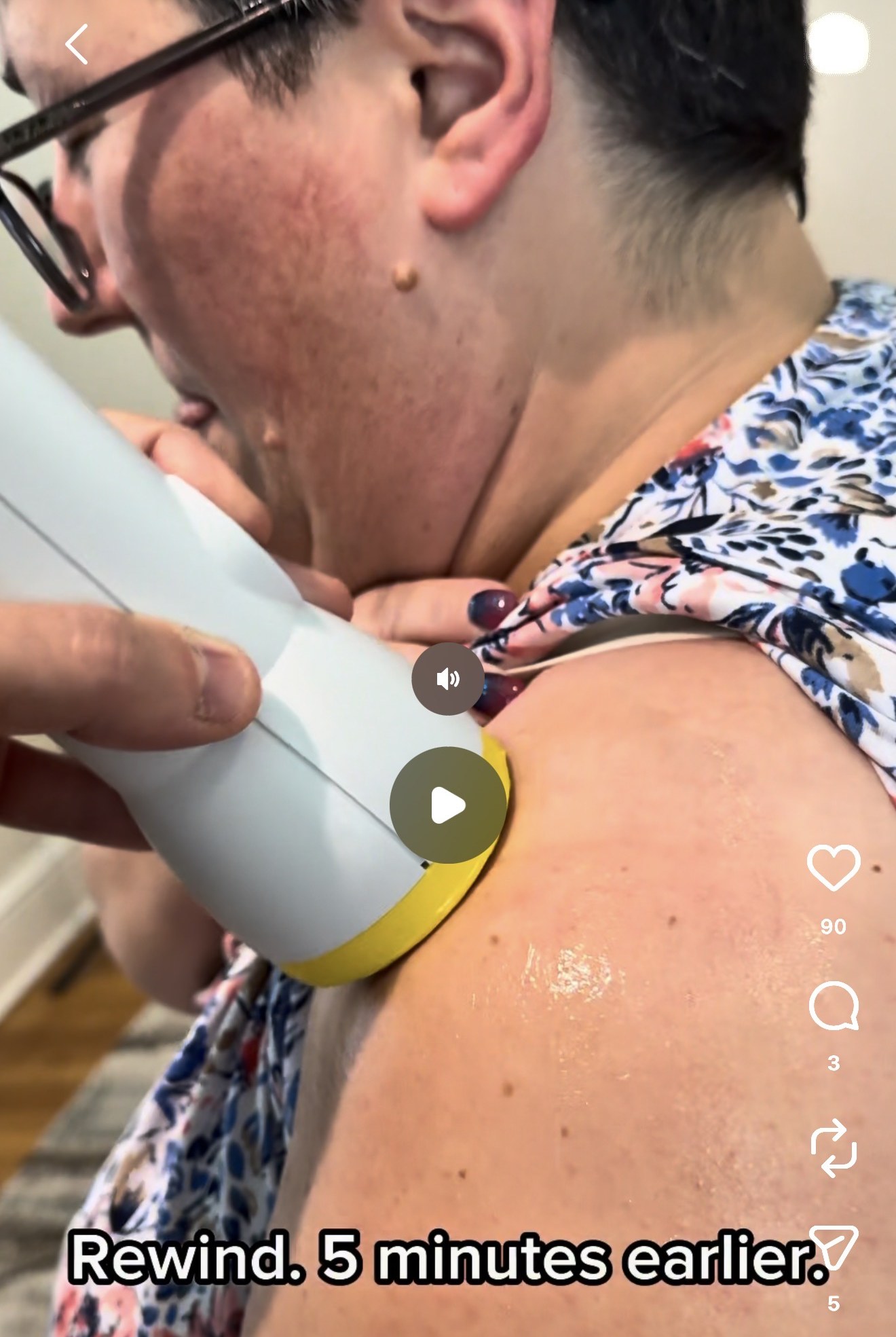
One of the least understood things about SoftWave therapy is that it isn't just a treatment — it's a diagnostic tool. When the applicator passes over healthy tissue, you feel essentially nothing. When it passes over damaged tissue, you feel it immediately — which means the machine shows us exactly where the injury is, in real time, without imaging. I'm Dr. Jeremiah Jimerson, and a recent patient's story shows why that matters more than almost anything else we do.
250 days of pain, and no way to see inside
A patient came to my Charleston office after 250 straight days of constant pain in her left shoulder — her dominant arm — with numbness running down it. By the time I met her, the pain had taken over every corner of her life. She couldn't sleep. Couldn't dress herself normally. Couldn't reach for a seatbelt without bracing for it. Eating, working, living — everything ran through that shoulder first.
Here's what made her case especially hard: she couldn't get an MRI. She has a brain implant, which ruled out the one imaging tool doctors lean on most for soft tissue injuries. Physical therapy had made her worse, so she'd stopped. A steroid injection didn't help. Her doctors, working without clear imaging, suspected the problem might actually be in her neck and were planning a CT scan to try to confirm it.
So after eight months, nobody could say for certain where the injury actually was. That's not a knock on her doctors — it's what happens when you can't see the tissue and the symptoms don't follow a textbook pattern.
The part of SoftWave nobody talks about
Most people hear about SoftWave as a healing technology — acoustic waves that stimulate blood flow, modulate inflammation, and activate the body's own repair processes. All true.
But the first thing SoftWave does in my office is find the problem.
The biofeedback is simple and honest: healthy tissue doesn't respond to the treatment — you don't feel anything. Damaged, inflamed, or restricted tissue responds immediately. As I move the applicator across an area, the patient tells me in real time where it lights up. No guessing, no waiting two weeks for a radiology report. The injured tissue announces itself.
With this patient, that mattered enormously. Instead of debating whether the problem was her neck or her shoulder, we mapped it directly — on the first visit.
What happened next
I'll let the numbers speak carefully here, because I know how this sounds: in the video, her pain went from a 10 to a 0 in minutes. She teared up in the chair — not from the treatment, but because it was the first relief she'd felt in the better part of a year. It was hard for her to comprehend. Honestly, moments like that are hard for me to comprehend, and I do this every day.
Now the honest doctor part: not every patient responds this dramatically — but rapid relief is exactly how we know. Here’s my benchmark: during the treatment included in your Discovery session, we should be able to get at least a 50% reduction in your pain (many get 100%). If we can do that, you’re a candidate for treatment — it means the tissue is responsive and we’ve found the right target, and the follow-up sessions are what make it last. SoftWave’s clinical success rates for musculoskeletal conditions are strong (studies report 65–91% depending on the condition), but “strong” isn’t “guaranteed,” and anyone who promises otherwise is selling something. What I can promise is that we’ll know very quickly whether SoftWave can help you — that’s exactly what Discovery Day is designed to answer.
Who this matters for
This diagnostic side of SoftWave is especially valuable if you're in one of these boats:
- You can't get an MRI — implants, pacemakers, claustrophobia, or cost
- Imaging came back "normal" but you're still in pain — scans show structure, not function
- Treatments keep missing — if PT, injections, or adjustments aimed at the wrong tissue haven't helped, the target may be wrong, not the treatments
- Your pain doesn't follow the textbook — referred pain and nerve symptoms often point away from their actual source
Frequently asked questions
Does SoftWave therapy hurt?
Over healthy tissue, you feel almost nothing. Over injured tissue, you'll feel a deep, specific discomfort — and that response is exactly what tells us we've found the problem area. Most patients describe it as intense but tolerable, and sessions take just 5–15 minutes.
Can SoftWave find an injury without an MRI?
It doesn't produce an image, but functionally, yes — the biofeedback response maps where tissue is damaged or inflamed in real time. For patients who can't have an MRI, it's one of the few ways to localize a soft tissue problem directly.
How fast does SoftWave work?
Some patients feel meaningful relief in the first session, like the patient in this video. Most notice significant change within the first several sessions, with the deeper tissue repair unfolding over the following 8–12 weeks. Our benchmark on Discovery Day: at least a 50% reduction in your pain during the treatment itself (many get 100%). If we can do that, you’re a candidate.
What if my doctors think the problem is somewhere else?
That's common — referred pain misleads everyone, including good physicians. Because SoftWave maps responsive tissue directly, it can confirm or challenge the working theory in minutes, which makes every other treatment decision smarter.
Dr. Jeremiah Jimerson, DC, ART provides SoftWave therapy in Charleston, SC. The $99 New Patient Special includes a consultation and a Discovery Day session — within minutes of your first treatment, we'll know whether SoftWave can help you. Request an appointment or call (843) 873-6004. Individual results vary; this patient's experience is her own.
‹ Back





 761 St Andrews Blvd